OKLAHOMA CITY – The Office of State Finance is no more—now it's the Office of Management and Enterprise Services, effective Friday, Aug. 24.
Saturday, September 1, 2012
Office of State Finance Undergoes Name Change
OKLAHOMA CITY – The Office of State Finance is no more—now it's the Office of Management and Enterprise Services, effective Friday, Aug. 24.
Tribal gaming fee growth slowing
Oklahoma State Capitol - After experiencing several years of extensive growth, state collection of fees on tribal gaming are showing signs of leveling off.
Oklahoma schools receive ACT scores, college readiness indicators
- 20.4 in English, below the national average of 20.5 and down from the state score of 20.5 in 2011;
- 20.1 in math, up from the state score of 19.9 in 2011 but below the national average of 21.1;
- 21.3 in reading, matching the national average and the state score from 2011; and
- 20.6 in science, the same as the state score from last year and below the national average of 20.9.
- 8 percent were African American with an average composite score of 17.4, up .2 percent from the state average last year and .4 percent about their national counterparts;
- 9 percent were American Indian with an average score of 19.4 percent. This is still .1 percent above the national composite for this group but down .1 percent from last year’s state score, with 2 percent fewer students from this group taking the ACT;
- 9 percent were Hispanic, up 1 percent from 2011, with a composite score of 19, up from the state score of 18.9 last year and .1 percent higher than national counterparts;
- 58 percent were Caucasian, down from 61 percent in 2011, with an average score of 21.6 percent, the same as last year in the state and below the national average of 22.4
- 3 percent were Asian American, the same as last year, with an average score of 22.7, up from 22.4 in the state for 2011 but below the national average of 23.6.
- Oklahoma School for Science and Mathematics, 31.7, 66 tested *
- Classen School of Advanced Studies (Oklahoma City) 25.6, 102 tested *
- Tulsa School of Arts and Sciences, 25.5, 31 tested
- Edmond North High School, 24.2, 508 tested; Norman North High School, 24.2, 325 tested
- Jenks High School, 23.6, 573 tested
- Edmond Memorial High School, 23.5, 404 tested
- Deer Creek High School, 23.4, 211 tested
- Booker T. Washington High School, 23.3, 308 tested *
- Harding Charter Preparatory High School, 22.9, 84 tested
- Stillwater High School, 22.8, 300 tested; Ada Senior High School, 22.8, 99 tested; Lomega High School, 22.8, 12 tested
Multicounty Grand Jury Indicts Former Broken Arrow Superintendent; Vendor
Indictments unsealed Thursday in Tulsa County
![]() |
| Attorney General Scott Pruitt |
Monday, August 27, 2012
IT Consolidation to Save Taxpayers $40 Million Annually
OKLAHOMA CITY – Oklahoma taxpayers are set to save $40 million during the current state budget year and each year thereafter, according to a recent report.
The Information Services Division of the state’s Office of Management and Enterprise Services released its fiscal year-end report detailing the savings from the recently enacted plan to consolidate state government information technology processes. The report shows savings estimates continuing to climb and demonstrates that approximately $40 million in annual savings has already been achieved even though many state agencies still have not been incorporated into the consolidation process.
The savings can be attributed in part to lower software costs due to the combining of the state agencies’ purchasing power and a 17 percent reduction in the number of IT positions needed to maintain the consolidated IT infrastructure. The plan also details additional levels of cost avoidance in addition to the $40 million in savings, including $1.8 million of potential cost avoidance after the centralized IT operation rectified software licensing-related liabilities previously incurred by state agencies.
When the Oklahoma Legislature passed the proposal, it required IT officials to realize a savings of at least 15 percent of the state’s IT spend. The report demonstrates that the consolidation has met this goal.
Last fall, Oklahoma Chief Information Officer Alex Pettit told the House Government Modernization Committee that the consolidation had allowed $30 million in annual savings. On the morning of Sept. 11, Pettit, will again testify before the committee and will inform members of the newest savings numbers. Pettit is expected to field questions on his department’s mitigation of legacy IT information security liabilities and the potential for additional savings as the consolidation continues.
“CIO Pettit is doing a fantastic job implementing this plan,” explained the consolidation’s legislative author, state Rep. David Derby, R-Owasso. “During the next legislative year, we are committed to continuing the passage of legislation that will enable these savings to continue.”
![]() |
| Rep. Jason Murphey R-Guthrie |
Pettit’s testimony is expected to take place at approximately 11 a.m. Sept. 11 in Committee Room 432A at the state Capitol building. The meeting is open and the public is encouraged to attend.
Tuesday, August 21, 2012
State Aid Allocation Increased to School Districts
The State Department of Education announced today that some state aid money previously held back to cover charter school enrollment is now being released to school districts.
Some public school officials have engaged in unjustified, shrill criticism of Superintendent Janet Barresi over the amount of state aid money held back by the State Department of Education. They have largely failed to acknowledge that recent financial decisions are reasonable and responsible under current circumstances.
Last month the State Department of Education was required to set aside enough money to cover potential enrollment in charter schools, including some charter schools that were still in the application phase. At the time the initial allocations for school districts were required to be calculated the charter school enrollment numbers were not known.
The Department of Education sent an email today notifying school districts of the amended initial aid allocation.
“As indicated this summer, now that August enrollment counts have been completed for public charter schools, the State Department of Education has adjusted initial state aid allocations and will be allocating an additional $9 million to all Oklahoma public school districts. Several public charter schools had lower enrollment numbers than initially anticipated, and several of the schools that applied for new charters this year will not open this semester.”
Friday, August 17, 2012
Fallin Appoints two Members to the DHS Commission
OKLAHOMA CITY – Governor Mary Fallin today announced the appointments of Pam Kanaly and Karen Waddell to the Commission for Human Services. The Oklahoma Commission for Human Services is a nine-member governing board for the Oklahoma Department of Human Services (OKDHS). Its members are appointed by the governor to staggered nine-year terms, with one membership expiring each August. These appointments fill all current vacancies on the OKDHS Commission.
“The ongoing reforms at the Department of Human Services – including the implementation of the Pinnacle Plan – are essential in our efforts to improve child welfare services,” Fallin said. “Both Pam Kanaly and Karen Waddell are respected and successful community leaders with a great deal of experience working with families and children. I know both are ready for the challenge and committed to serving on the Commission in order to help the agency to better protect and serve the children and citizens of Oklahoma.”
Pam Kanaly of Edmond is the president and co-founder of Arise Ministries, a national women’s outreach organization founded in 2002 that works to strengthen families and support single mothers. Prior to her work with Arise, Kanaly taught elementary and junior high school in Texas. Kanaly is a member of the Greater Oklahoma City Chamber of Commerce and the Edmond Chamber of Commerce. She received a bachelor’s degree in elementary education from Texas Tech University. Kanaly is replacing Jay Chase, who is deceased, and will serve through August 2015.
Karen Waddell of Edmond is the president of the Lynn Institute for Healthcare Research. She also serves as the president of two other companies, the Lynn Health Science Institute, a clinical trials organization and Karen Vinyard Waddell and Associates, a company that specializes in training programs for at-risk children and their families. She previously worked as president of Eckerd Youth Alternatives, a behavioral health and child welfare services center. Waddell also served as the assistant vice president of the University of Oklahoma Health Sciences Center. She received a bachelor’s degree from the University of Oklahoma. She is replacing Richard DeVaughn and will serve through August 2021.
Monday, August 13, 2012
Ultimate Education Accountability: Henry Scholarships
Oklahoma Capitol - (Commentary) I received an anonymous comment on a blog post recently implying the Lindsey Nicole Henry Scholarship Program lacks accountability. That’s news to me and to the parents and students using the program.
In some respects, private schools are accountable just like public schools. Both public and private schools answer to boards. The anonymous writer, who posts under the pseudonym okeducationtruths, acknowledges that private schools, like public schools, must also be accredited by the State Department of Education.
“The program of the school shall be designed in the best interests of the students, and students are admitted only when it has been determined that there are reasonable expectations that the students' best interests can be served. The program, while appropriately adjusted to serve the best interest of its students and to be consistent with the school's philosophy and objectives, complies with applicable rules of the State Board of Education, especially in the following areas: (i) Length of the school day and school year; (ii) The basic skills subjects in the elementary curriculum including subjects which constitute a well-balanced elementary curriculum; instructional time requirements and essential elements which are comparable to those required in the like subjects at equivalent grade levels in the public school system; student academic records; and achievement levels required for promotion; and (iii) The appropriate subjects in the secondary curriculum, including sequencing of courses for which transferability of credit may be sought from the state; essential elements which are comparable to those required in the like subjects and courses at equivalent grade levels by the state; student academic records; and achievement levels necessary for the awarding of credits and diplomas.” Also, “Professional staff members must hold degrees and be qualified by preparation or experience for positions they hold and for the work to which they are assigned.”
“[E]ducators are greatly concerned at the very real possibility that a student with special needs can be pulled out of a public school and placed in a private school that may not offer any Special Education services.”
"Parents, I'm afraid, are unaware what they are giving up. Our concern is that our students are out there without anyone watching over them."
“[Parents] are giving up due process rights, continued IEP, auxiliary services, free and appropriate education, annual evaluations. ... There are a variety of things guaranteed to students and parents that would be lost."
Former State Rep. Neil Brannon, D-Arkoma, said during his debate against the program on the House floor, “[Parents] may think they know what’s best, but do they?”
Conquer Math at the Khan Academy
OKLAHOMA CAPITOL - Could your child use a free, effective math tutor after the summer break? Then you should check out the Khan Academy - It’s online, free and amazing!
Arithmetic and Pre-algebra
Algebra
Geometry
Trigonometry
Probability
Statistics
Precalculus
Differential Equations
Linear Algebra
Brain Teasers
VI Hart
Biology
Chemistry
Organic Chemistry
Healthcare and Medicine
Physics
Cosmology and Astronomy
Computer Science
Brit Cruise
MIT+K12
Core Finance
Valuation and Investing
Venture Capital and Capital Markets
Credit Crisis
Paulson Bailout
Geithner Plan
Current Economics
Banking and Money
Currency
Microeconomics
Macroeconomics
History
American Civics
Art History
SAT Math
GMAT
CAHSEE
California Standards Test
Competition Math
IIT JEE
Singapore Math
Saturday, August 11, 2012
Department of Education Details Data Pipeline Project
State Capitol - The State Department of Education today announced a new collaborative effort with the Office of State Finance’s Information Services Division (OSF/ISD), the Cooperative Council for Oklahoma School Administrators (CCOSA) and the Oklahoma State School Boards Association (OSSBA).
The effort is called the Data Pipeline Project and is a new partnership with school districts. The goal of the project is to resolve data collection and reporting challenges districts face.
The Data Pipeline Project will result in local and state data systems that are less expensive, more efficient, produce better data and lead to better outcomes for students.
The SDE issued a letter explaining the project along with additional documents detailing how districts may participate. Also included is information about the scope and timeline for the project.
- Data Pipeline Project Participation .pdf
- Data Pipeline Project Scope-Timeline.pdf
- Data Pipeline Project Letter 08102012.pdf
Thursday, August 9, 2012
Fallin's Recent Education Appointments
Oklahoma Board of Private Vocational Schools
Jeremy Gibson of Tulsa is the chief executive officer and president of Spartan College. He previously served as president of Nashville Auto/Diesel College in Tennessee. Gibson received his master’s degree in business at the Xavier Business College in Sydney, Australia. He is replacing Andrew Moore and represents an executive or managerial position in private vocational schools.
State Textbook Committee
![]() |
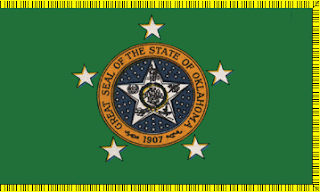
| The Flag of the Governor of Oklahoma |
Sherry Campbell of Nowata is a teacher at Nowata Public School, where she has taught for more than 20 years. She is a member of the Oklahoma Council for Social Studies and the Oklahoma Alliance for Geographic Education. Campbell received a bachelor’s degree from Bartlesville Wesleyan College. Campbell is replacing Nancy Hindenburg, is certified in social studies and will represent the Second Congressional District.
Patti Harrold of Edmond is a history teacher and department chair for Edmond Public Schools. She is a member of the Professional Oklahoma Educators, National Social Studies Supervisors Association and was a founder and past president of the National Council for History Education. Harrold received a bachelor’s degree from Oklahoma City University and a master’s degree from Lamar University in Beaumont, Texas. She is replacing Vicki Vaughan, is certified in social studies and will represent the Fifth Congressional District.
Oklahoma Educational Television Authority
Jerry Nye of Weatherford is a retired professor from Southwestern Oklahoma State University, where he taught English, speech, journalism and language arts. He is an honorary lifelong member of the Oklahoma Council of Teachers of English. Nye is a veteran of the Korean War where he served in the U.S. Army Corps of Engineers. He earned a bachelor’s degree in education from Easter Central University, a master’s degree from Oklahoma State University, and a doctorate degree from the University of Northern Colorado. Nye is replacing Mary Ferguson and will represent the third Congressional District.
Wednesday, August 8, 2012
Supporters of the Lindsey Nicole Henry Scholarships speak out
My thanks to the Oklahoma Council of Public Affairs for hosting a great event at the University of Central Oklahoma last week. OCPA hosted a screening of a new documentary about the Lindsey Nicole Henry Scholarship Program. Supporters turned out to express their enthusiasm and personal connection to Lindsey Nicole Henry Scholarship recipients. Several of these attendees went "on the blue carpet with OCPA" to answer a simple question: "Why the Lindsey Nicole Henry Scholarship Program?"
Monday, August 6, 2012
Commentary: How do you know private schools do it better?
This is a question I’m asked repeatedly regarding the Lindsey Nicole Henry Scholarship program. This unedited question is copied straight from an email I received.
There are two ways to answer this question - a long answer and a short answer. I’ll give both.
The first answer: I assume that do it better really means provide a better education. Certainly that is important but there is another consideration for many parents. It could, and probably should, also refer to doing a better job of protecting children with special-needs from bullying. Bullying unaddressed by educators in some public schools is the reason many parents decide to use the scholarship - not academic reasons.
Most detractors don’t know that participating private schools have to meet certain standards. For instance, private schools that choose to participate in the program must meet accreditation standards set by the State Board of Education. Unlike poor performing public schools, private schools that do a bad job educating children run out of paying customers because students can take their money to a school that does it better.
The question also seems to assume that what I think about private schools matters to parents. I’m not the one choosing which children participate or which private school they will attend. The law does not grant me the responsibility of arbitrarily assigning participating children to specific private schools by some nonsensical system such as basing it on their home address. That is how children are currently assigned to schools in the public system. In the Henry Scholarship program, parents are solely responsible for choosing the private school their child will attend.
The Lindsey Nicole Henry Program makes an assumption, which I believe to be accurate, that parents who choose to use the program love their children more than the public school system does and that parents are perfectly capable of making big decisions that are in the best interest of their child. In this case, it is the process of researching and selecting a suitable private school.
The question is always general in nature. Parents are not choosing between an idea like public schools and a different idea such as private schools. Parents who are using the program are choosing to transfer a particular child from a specific public school to a specific private school. So the answer to the question depends not on a general idea, but on which specific private school is in question.
The law does make a general value judgement: More options are better than fewer options. Parents make the specific value judgments of whether to participate in the program and what private school their child will attend.
At this point, the question has been answered but the answer is longer than necessary. I usually just give a one sentence answer styled as a question. I think it makes my point perfectly if children are our first concern.
How do you know the public school to which a child is assigned does it better?
Thursday, August 2, 2012
ACE appeals to be considered at special State Board of Ed meeting
Oklahoma Capitol - A special meeting of the State Board of Education has been called tomorrow, Friday, Aug. 3 at 10 a.m.
Wednesday, August 1, 2012
New Documentary on Lindsey Nicole Henry Scholarship Posted
Update: On Nov. 20, 2012, the Oklahoma Supreme Court tossed out the lawsuit against the parents of student with special needs.
Please take time to watch this powerful 25 minute documentary and then share it with your friends and social media networks.
Earlier this year a district judge in Tulsa County ruled that this life-changing special education school choice program was unconstitutional. The judge gave no basis for the decision. The judge did allow the program to continue during appeal.
The case is currently on appeal with the Oklahoma Supreme Court. Supporters, and some who oppose the program, asked in separate requests in June for permission to file additional legal briefs in the case. The attorney general and the parents who were sued by two public school districts for using the program have also asked for the opportunity to present oral argument to the court. The Supreme Court has not addressed these requests.
The Court could issue a decision any day without addressing the pending requests.
The documentary was shown for the first time last night before a public audience on the University of Central Oklahoma campus. The showing was followed by a panel discussion on the status of the program.
I will be providing timely updates on this blog as events unfold and I also recommend that you visit https://www.facebook.com/HenryScholarships to learn more and share your stories.
Thank you for taking the time to watch this important documentary and to learn more about this successful but threatened program.
Please take time to watch this powerful 25 minute documentary and then share it with your friends and social media networks.
The case is currently on appeal with the Oklahoma Supreme Court. Supporters, and some who oppose the program, asked in separate requests in June for permission to file additional legal briefs in the case. The attorney general and the parents who were sued by two public school districts for using the program have also asked for the opportunity to present oral argument to the court. The Supreme Court has not addressed these requests. Chiefs for Change States Pave the Way to Student Improvement
Washington, D.C. – As states nationwide announced their end-of-year assessment test results, five Chiefs for Change states – Indiana, Louisiana, New Mexico, Oklahoma and Tennessee – reported noticeable improvements in academic achievement. The increased test scores are attributed to the adoption and implementation of a number of education reforms in these states in recent years that focus on accountability and higher standards.
Indiana
The 2012 Indiana Statewide Testing for Education Progress Plus (ISTEP+) resulted in record-breaking scores, with one-year gains in all subject areas. Since the 2008-2009 school year, Indiana students have achieved gains of at least eight percentage points in each subject tested. Overall, 71 percent of students passed both the English Language Arts and Math portions of the test, representing a one percent gain over the previous school year and an eight percent gain since 2008-2009.
Louisiana
Louisiana’s end-of- year assessment tests for the 2011-2012 school year resulted in statewide gains in academic achievements, with nearly 10,000 more students at grade level this year as compared to the previous year. Specifically, the percentage of students performing at grade level for all grades and subjects grew two percentage points from 66 percent in 2011 to 68 percent in 2012. The two-point gain represents the largest in three years.
New Mexico
Results for the 2012 State Based Assessment (SBA) exam showed marked improvement in many areas. Specifically, seventh grade math scores improved 4.1 percent, fourth grade reading scores improved 3.4 percent and fifth grade reading scores improved 3.1 percent. Overall reading and math scores increased by approximately one percent from the previous year, with roughly 50 percent of the students tested (third through eighth grades and 11th grade) reading at grade level and 43 percent solving math problems at grade level.
Oklahoma
Oklahoma’s Achieving Classroom Excellence end-of-instruction tests in critical math subjects showed significant gains, with Algebra II scores up 21 percentage points compared to 2008. Students also showed notable gains in Geometry and English III, with increases of 14 percent and 10 percent, respectively, since 2008. Additionally, writing scores in the Oklahoma Core Curriculum Test increased by five percent over last year, with 90 percent of eighth graders showing proficiency in 2012.
Tennessee
Student performance on the 2012 Tennessee Comprehensive Assessment Program (TCAP) improved statewide for the second year in a row, resulting in the highest aggregate test-score gains in state history. Students in grades third through eighth reached higher levels of proficiency in 23 of the 24 TCAP assessments, achieving the highest scores in reading, math and science. High school students also showed significant improvement, with more than half of them scoring proficient or advanced in a number of subjects including algebra and biology.
“The time for complacency and the status quo in public education has passed. Leaders, educators and parents throughout the country are reclaiming the futures of their students,” said Patricia Levesque, executive director at the Foundation for Excellence in Education. “All children can learn; and, thanks to bold state leadership and committed teachers, students in these states will be better prepared for success in college and their careers. As more states make transforming education for students a priority, the sky will be the limit of what today’s students – tomorrow’s leaders – can achieve.”
Comprehensive education reforms have been the topic of much discussion at the state level as governors and legislatures across the country continue to pass and sign bold reforms into law. New Jersey lawmakers took a tremendous step this legislative session toward modernizing the teaching profession in their state by unanimously passing a student-centered bill that increases teacher accountability. New laws and regulations in Rhode Island promote virtual learning, expand career-technical education, and provide access to more Advanced Placement (AP) courses. Additionally, the State opened a “Data Hub” that brings together student data from prekindergarten through college to promote continuous improvement of teaching and learning. Maine Governor LePage issued an executive order requiring the Maine Department of Education to pursue a strategic plan for digital learning that includes more course options for students, especially those in smaller and more rural schools, and the renewal of the highly successful Maine Learning Technology Initiative. Additionally, Florida introduced higher assessment standards this year to its Florida Comprehensive Assessment Test (FCAT), and was ranked second in the nation in test-score gains in a report released this month by Education Next.
“These states, along with the other Chiefs for Change states, are setting an example for the entire nation,” said Chiefs for Change Executive Director Eric Smith. “The comprehensive reforms adopted in each state have resulted in students and teachers meeting more rigorous academic standards, and, as a result, they are making significant progress across the board – especially in core areas like math, science and reading.”
Indiana
The 2012 Indiana Statewide Testing for Education Progress Plus (ISTEP+) resulted in record-breaking scores, with one-year gains in all subject areas. Since the 2008-2009 school year, Indiana students have achieved gains of at least eight percentage points in each subject tested. Overall, 71 percent of students passed both the English Language Arts and Math portions of the test, representing a one percent gain over the previous school year and an eight percent gain since 2008-2009.
Louisiana
Louisiana’s end-of- year assessment tests for the 2011-2012 school year resulted in statewide gains in academic achievements, with nearly 10,000 more students at grade level this year as compared to the previous year. Specifically, the percentage of students performing at grade level for all grades and subjects grew two percentage points from 66 percent in 2011 to 68 percent in 2012. The two-point gain represents the largest in three years.
New Mexico
Results for the 2012 State Based Assessment (SBA) exam showed marked improvement in many areas. Specifically, seventh grade math scores improved 4.1 percent, fourth grade reading scores improved 3.4 percent and fifth grade reading scores improved 3.1 percent. Overall reading and math scores increased by approximately one percent from the previous year, with roughly 50 percent of the students tested (third through eighth grades and 11th grade) reading at grade level and 43 percent solving math problems at grade level.
Oklahoma
Oklahoma’s Achieving Classroom Excellence end-of-instruction tests in critical math subjects showed significant gains, with Algebra II scores up 21 percentage points compared to 2008. Students also showed notable gains in Geometry and English III, with increases of 14 percent and 10 percent, respectively, since 2008. Additionally, writing scores in the Oklahoma Core Curriculum Test increased by five percent over last year, with 90 percent of eighth graders showing proficiency in 2012.
Tennessee
Student performance on the 2012 Tennessee Comprehensive Assessment Program (TCAP) improved statewide for the second year in a row, resulting in the highest aggregate test-score gains in state history. Students in grades third through eighth reached higher levels of proficiency in 23 of the 24 TCAP assessments, achieving the highest scores in reading, math and science. High school students also showed significant improvement, with more than half of them scoring proficient or advanced in a number of subjects including algebra and biology.
“The time for complacency and the status quo in public education has passed. Leaders, educators and parents throughout the country are reclaiming the futures of their students,” said Patricia Levesque, executive director at the Foundation for Excellence in Education. “All children can learn; and, thanks to bold state leadership and committed teachers, students in these states will be better prepared for success in college and their careers. As more states make transforming education for students a priority, the sky will be the limit of what today’s students – tomorrow’s leaders – can achieve.”
Comprehensive education reforms have been the topic of much discussion at the state level as governors and legislatures across the country continue to pass and sign bold reforms into law. New Jersey lawmakers took a tremendous step this legislative session toward modernizing the teaching profession in their state by unanimously passing a student-centered bill that increases teacher accountability. New laws and regulations in Rhode Island promote virtual learning, expand career-technical education, and provide access to more Advanced Placement (AP) courses. Additionally, the State opened a “Data Hub” that brings together student data from prekindergarten through college to promote continuous improvement of teaching and learning. Maine Governor LePage issued an executive order requiring the Maine Department of Education to pursue a strategic plan for digital learning that includes more course options for students, especially those in smaller and more rural schools, and the renewal of the highly successful Maine Learning Technology Initiative. Additionally, Florida introduced higher assessment standards this year to its Florida Comprehensive Assessment Test (FCAT), and was ranked second in the nation in test-score gains in a report released this month by Education Next.
Chiefs for Change is a coalition of state school chiefs and leaders that share a zeal for education reform. Together, they provide a strong voice for bold reform on the federal, state and local level. It is committed to putting children first through bold, visionary education reform that will increase student achievement and prepare students for success in colleges and careers. Learn more at www.ChiefsForChange.org.
Subscribe to:
Posts (Atom)


